Short-Time Work, its Replacement Rate and Labour Mobility
Abstract
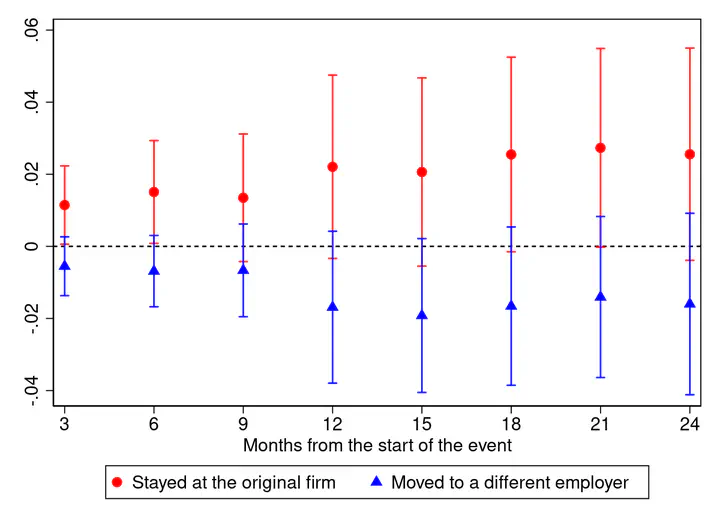
This paper studies the impact of the short-time work (STW) replacement rate on workers’ job-to-job mobility. Exploiting a discontinuity in the Italian STW schedule and matched employer–employee data, we show that a 10-percentage-point increase in the replacement rate raises the probability of remaining with the current employer by 3%, reducing job-to-job flows. The effect is driven by low-ability workers, whose transitions to higher-paying firms decline, implying a deterioration in workforce quality in STW firms. We develop a model to rationalise these results and derive an optimal STW formula. The fiscal externality is positive but smaller than for unemployment benefits.

Lorenzo Pesaresi
Research Fellow
I am a Research Fellow in Economics at the Bank of Italy. My research interests are in Macroeconomics, Labor Economics, Search Theory, and Monetary Economics.